What Your Tax Bill Has to Do With the “One More Year” You Keep Promising Yourself
The number most people use for one more year is what they earn, not what they keep after taxes. And when the number is reached, it moves: a client at $5 million said one more year, and in a Harvard study three in four millionaires said they would need at least double. Another year only changes something if it changes the shape of your days. The worksheet asks you to say, in specifics, what that is.
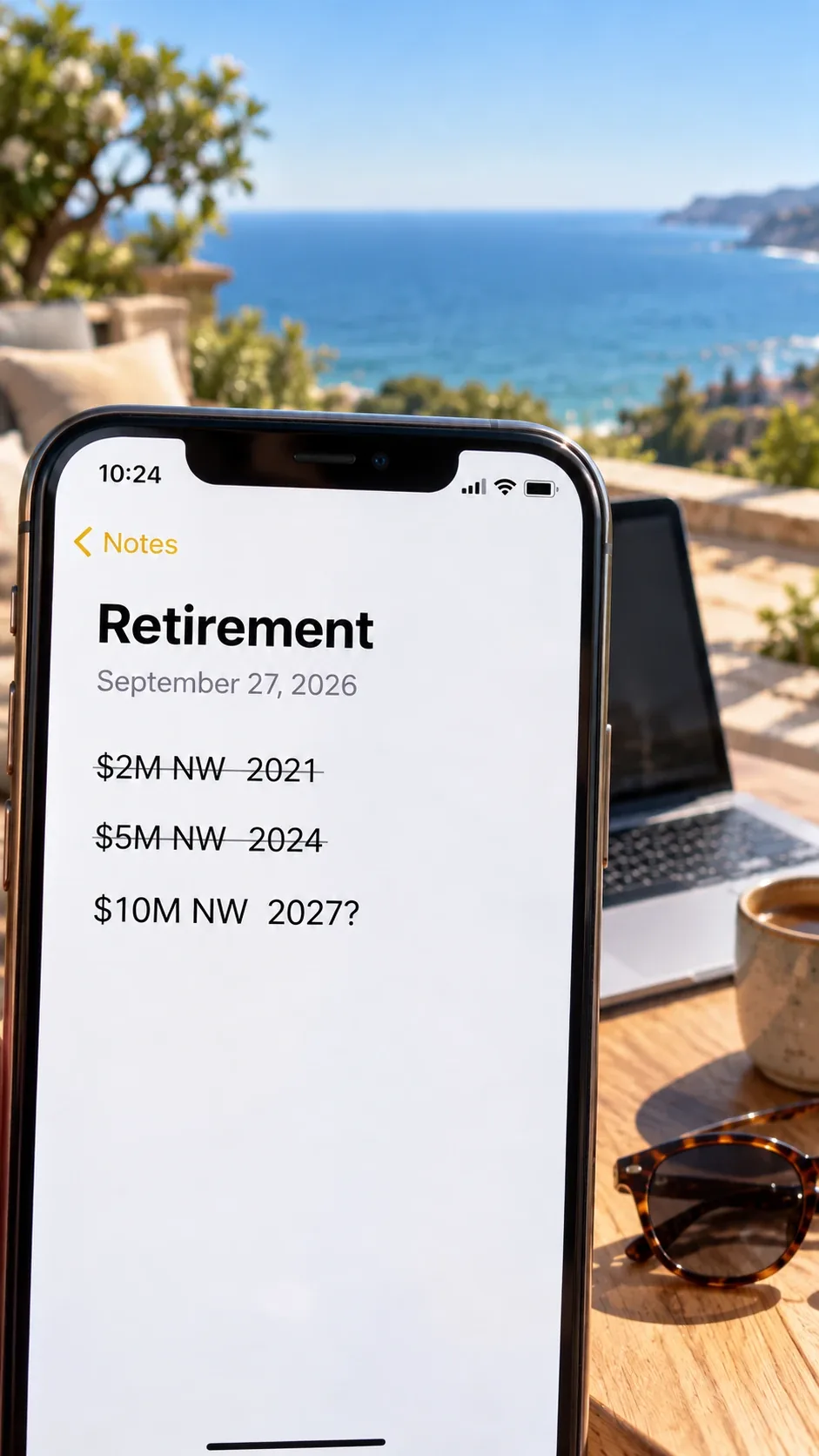
“One more year.”
You’ll earn a little more. Build a little more cushion. Then you’ll give yourself permission to slow down.
But when you picture that extra year, which number are you using? The amount you earn, or the amount you actually keep after taxes?
And what are you asking yourself to give up in exchange?
A client once checked his accounts, his investments, his assets, his retirement, and they were at \$5 million cumulatively. Exactly where he wanted them to be before he walked away from his soul-destroying job. And then he said to himself, “Just one more year. Just one more year, and then I’ll have enough.”
He had set the goal and reached it. And the moment he reached it, his goal changed.
If it can happen at \$5 million it can happen at any number, and it has nothing to do with how much you have. It has to do with what happens inside you when you get what you were working for. For most people, what happens is this: the achievement does not land as “enough”.
It lands as the new minimum. Every milestone becomes another starting line. Every finish line instantly moves further away.
He is not unusual. In 2018, researchers at Harvard Business School surveyed more than 4,000 millionaires and asked the ones who were not already 10/10 happy how much more wealth it would take to get them there.
About three in four said they would need at least double what they had.
One in four said ten times.
And the answer did not depend on how much they already had: people worth \$10 million wanted the same multiple as people worth \$1 million.
So the goal moves at every level, and another year of earning does not stop it moving.
Which means the useful question is not “how much more do I need?” It is “what is this year actually going to change?”
For the client with the \$5 million, another year was only worth it if the money bought him room to live: fewer hours, fewer things that only he could do, more days that were free. If his days were going to look the same, it wouldn’t matter if he had more money. He would still feel exactly the same.
So here is our question for you:
Could you live like this for another 20 years? Not 5, because anyone can muscle through 5 years. 20. If the answer is no, what needs to change?
Most people answer that question with a feeling.
The “One More Year” Reality Check asks you to answer it with specifics.
When you know how that year will affect your finances, your lifestyle and what you are giving up in order to do it, you get the full picture.
When you have the full picture you get your agency back. You can CHOOSE to do this for one more year because the logistics actually work out and the results justify the costs.
When you are clear, you don’t have to make any choices out of fear. And that’s a powerful position to be in.
Get clear on what needs to change next year
By all means, work one more year. But do it with radical intentionality and not because you just don’t know what else to do.
Strategic Stewardship
Sources
- Grant E. Donnelly, Tianyi Zheng, Emily Haisley and Michael I. Norton, "The Amount and Source of Millionaires' Wealth (Moderately) Predicts Their Happiness," Personality and Social Psychology Bulletin, 2018, vol. 44(5). Two surveys of millionaires: 2,129 people with a net worth of at least $1.5 million, and 2,026 with at least $1 million. Read the study ↗
Ready to remove your income locks?
Strategic Stewardship is a one-year private program that works on all four locks at once, with a coach.
Apply now